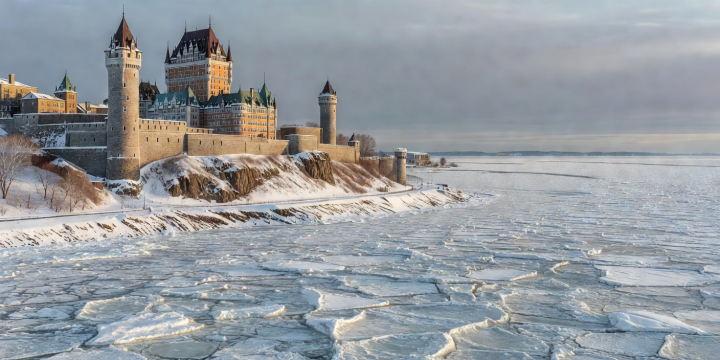
Estuary Climatology and Cold Air Drainage
Quebec City occupies a decisive geographical choke point where the Saint Lawrence River narrows between Cap Diamant and Lévis. The climate is humid continental, characterized by vast temperature swings and heavy seasonal snowfall originating from moisture drawn up the Atlantic seaboard (Nor'easters) colliding with cold northern air from Hudson Bay.
The Saint Lawrence River experiences dynamic winter icing. Massive tidal fluctuations combined with continuous river currents break the ice sheet into moving floes rather than a uniform solid surface. High winds channelled along the river valley create intense wind chill factors across the Upper Town (Haute-Ville), while the cliff-shielded Lower Town (Basse-Ville) experiences localized cold-air pooling.
Urban Maintenance Engineering in Historic Quarters
Maintaining a functioning modern municipal economy within seventeenth- and eighteenth-century fortified masonry requires specialized winter maintenance strategies:
- Mechanical Snow Extraction: Narrow, cobbled streets in the Old Port and Place Royale prevent roadside snow plowing. Municipal crews deploy compact loaders and blowers that load snow directly into dump trucks for transport to snow-dump sites outside the city core.
- Rampart and Stairway Safety: The steep elevation change between Upper and Lower Town is navigated via steep staircases (including the Escalier Casse-Cou) and the historic Funiculaire du Vieux-Québec. Specialized heated handrails and automated salt-brine sprays maintain pedestrian passage on exposed inclines.
- River Icebreaking Services: The Canadian Coast Guard maintains continuous icebreaking operations along the river channel, ensuring uninterrupted passage for the Lévis passenger ferry, which operates as a critical commuter link through moving ice floes.
Trade-offs: Urban Historic Enclave vs Mountain Wilderness
Balancing Quebec City against pure backcountry or ski-resort destinations highlights distinct operational parameters:
Pedestrian Density vs Open Terrain: Quebec City provides complete urban shelter, indoor culinary corridors, and continuous access to services. However, cold winds off the river require protective face gear during pedestrian transit across the Plains of Abraham or Dufferin Terrace.
Proximity to Boreal Wilderness: The city serves as an immediate gateway to the Laurentian Highlands (Jacques-Cartier National Park and Mont-Sainte-Anne), situated within short driving intervals north. This allows travellers to combine high-density urban accommodation with direct day-trip access to boreal snowshoeing and cross-country ski networks.
Logistical Planning Points
Key operational criteria for planning an itinerary in Quebec City include:
- Rail Intercity Transit: Via Rail operates regular corridor services connecting Quebec City (Gare du Palais) directly to Montreal and Ottawa, offering an alternative to highway transit during winter storms.
- Vehicle Regulations: The province of Quebec legally mandates winter tyres on all passenger vehicles between 1 December and 15 March; all car rental fleets comply with the mountain-snowflake rated tyre rule.
- Building Ingress Management: Historic buildings frequently employ temporary double-door wooden vestibules (tambours) installed over entryways to block wind drafts and maintain thermal efficiency.